
Content Warning
The life of the girl with the notebooks, fifty years ago

My mission is to show what it was like to be a child losing a parent to cancer. I remember how normal I was on the outside, and what I was thinking and feeling on the inside, and I’m certain that adults who haven’t experienced this type of early loss have no idea what it’s like. Nobody knew in real time how I was managing very heavy observations and frightening realizations, and for decades I didn’t talk about them. The eleven-year-old girl that I was, who lacked the words for her experience, deserves a voice. I can feel her excitement at having her stories told and I’m grateful to her for keeping a journal—emulating Harriet the Spy—starting at age ten.
This year-end is the 50th anniversary of my mother’s final terminal illness, and I’m thinking a lot about what she and I and my father and the rest of the family went through.
So, content warning: end-stage cancer.
***
I remember thinking, maybe when I was in college, “I can’t wait till I’m old and can remember tons and tons of things.” Now I do remember tons of things, including fifty years ago this month, the month I started sixth grade. That fall, my life was about to change completely.
Every time I write or speak about this period, I feel the isolation of being the lone child in the crucible of a small house with three adults, one of whom was my mother, who was being cared for by her mother and by my dad because she was dying. I had close best friends, but no adult confidant to share my assumptions and fears. It would have been helpful, though it would have taken a lot of time and attention, for someone to draw out my complicated feelings and confusion. I had always gone to my mother with every problem, and she seemed infinitely wise, but now she was dying and I never talked with her about that.
So my feelings and beliefs were mute. My journal describes surrounding events, but never mentions the grim events of my mother’s illness.
A few years ago, when I typed my journals, I built a timeline with every event mentioned no matter how minor. My original purpose for the timeline was to avoid confusion when I started writing memoir, but I soon saw that I could assign dates to some memories with a little research. I spoke to my two aunts and my older cousins to see what they remembered; I looked up historical weather (I was always aware of the weather as part of my world, so it’s tied to a lot of memories); and I used the orderly timeline itself to find plausible dates for memories. Some things, once the timeline was laid out, clearly had to have happened before or after other landmarks. Just that plus the weather was often a big help.
The timeline helps me make sense of the progression of my mother’s illness, and it shows me how much was going on in my life simultaneously. Even though I was only eleven, each day had a lot of moving parts. I think adults forget how complex a child’s world is, and that the little brain is as full of urgent flying thoughts as an adult’s is.
So, here’s a not-fully-contextualized list of what was happening fifty years ago in September 1975. My inner eleven-year-old thanks you for reading and wants you to know she has a fine life despite this stuff, and the content warning applies here:
I went to gymnastics after school one or two days a week starting in September, because my mom made me. I wanted to quit. I was too stiff for gymnastics, I said, and the girls I walked homeward with weren’t nice.
My mother had been very sick, rarely leaving the house, for most of the year (nine years after her first cancer diagnosis). Her 70-year-old mother had been living with us for over a year, and I felt guilty about our needing her care.
My mom stayed in bed most of the time. Sometimes I crawled in with her and we’d talk about my day. One time she asked me if I’d started menstruating yet. It frightened me that she thought it could have happened without her knowing. I think she had been non-lucid for a while at that time, but I had no idea of that. I would have found that very scary.
September was probably the month when I became conscious that my mom’s health had only gotten worse, and never better, for a long time. As my mind added up what this meant, a zipped-up curtain seemed to part and reveal the future. I knew what was going to happen. It was a bad thought that I had not asked for but couldn’t deny. My own brain had generated the thought, the belief, the knowledge that my mother was going to die.
I thought it was a sin to think that, though I hadn’t done it voluntarily. Was it really knowledge of the future or was it a hunch I needed to stop believing in? I didn’t know. Nobody knew what I was thinking. Even if someone, like one of our kind neighbors or my mom’s best friend, had asked “Do you have any questions about what’s happening to your mom?” I doubt I would have told them about this hunch. Or maybe I would have. There’s no way to know.
By September, my poor mother had been wasting away for months, a very long time. (It was at least eight months; that’s over five percent of my lifetime at eleven.) Her severely emaciated state, a state many people have never witnessed in real life, was a state I thought I was used to at age eleven. As long as she could talk to me, she was still her regular self, to me.
My dad and a neighbor took me and the neighbor’s kids out to a sunny forest preserve late in the month to bounce around in the fallen leaves and climb trees. I described the scene in detail in my journal: crunchy leaves, swaying treetops, dirt slopes down to a creek.
Several girls at school started mocking me together.
My mom said, lying in the bed, “They needed a scapegoat. I wish they hadn’t picked you.”
Sometimes I had a strong feeling that nothing was real. I was in a rehearsal that never stopped.
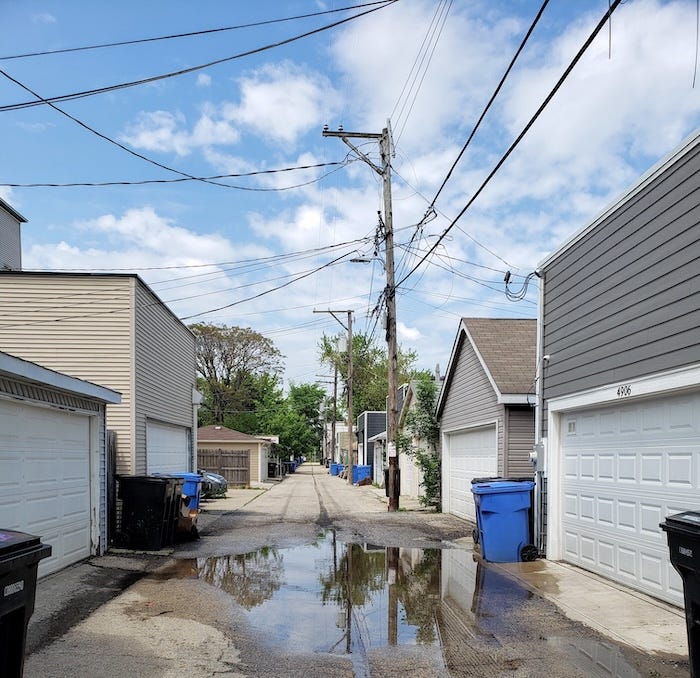
I liked to look down at rain puddles on the sidewalk and see the treetops reflected there.
One popular, down-to-earth girl at school became my friend that month instead of picking on me. She was the best.
Our 11 year old selves are 7 years apart, and the circumstances of our Moms' deaths very different, yet I can relate to the jumble of thoughts and questions that were in your head, and the lack of an adult to confide in. It was a very lonely time. 💙
❤️